Authorship
1. Authorship Criteria
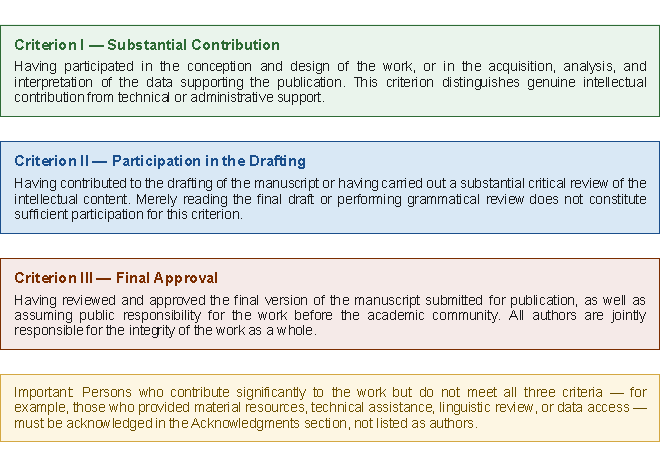
A person is considered an author of a work published in this journal if they have contributed intellectually in a significant way. To be recognized as an author, a person must simultaneously meet all three of the following criteria:
2. Participation Limits per Calendar Year
To ensure an equitable distribution of publication opportunities and encourage the participation of the greatest possible number of researchers from the Pan-American community, the following participation limits per calendar year (January–December) are established:
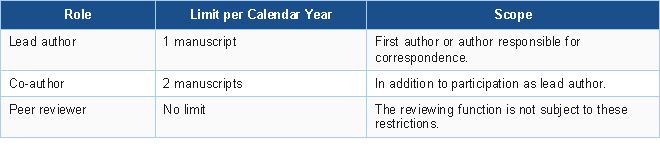
The maximum total participation of one person in the same year is one manuscript as lead author and two additional manuscripts as co-author, which is equivalent to a maximum of three publications as a signatory.

3. Author Identification and Order
3.1 Signature Order
The lead author is listed first. Co-authors are listed in order of importance or magnitude of contribution to the work, agreed upon by consensus among all signatories before submission. The journal does not intervene in the determination of authorship order, which is the exclusive responsibility of the research team.
It is strongly recommended that the team discuss and agree on the authorship order, individual roles, and terms of the conflict of interest declaration before drafting the manuscript, not at the time of submission.
3.2 Required Data from Each Author
Each signatory of the manuscript must provide the following information on the title page:
- Full name (given name(s) and surname(s), in the order preferred by the author).
- Institutional affiliation: institution, department or faculty, city and country.
- ORCID number (mandatory). Authors without ORCID must register for free at www.orcid.org before submission.
- Institutional or professional email address of the corresponding author.
- Conflict of interest declaration (or explicit declaration of no conflict).
- Funding source for the work (if applicable).
3.3 Corresponding Author
A single corresponding author is designated per manuscript. This person is responsible for all communications with the editorial team during the evaluation, revision, and publication process. Their email address will be published with the article to facilitate contact from interested readers and researchers.
4. Authorship Roles Declaration — CRediT Taxonomy
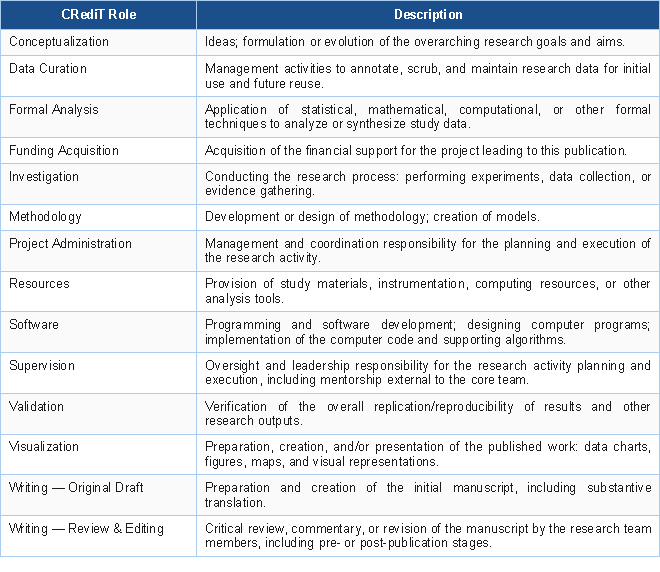
To ensure maximum transparency in the attribution of individual contributions, all manuscripts must include an authorship roles declaration using the CRediT (Contributor Roles Taxonomy). This taxonomy defines fourteen standardized roles covering the entirety of the research and publication process.
Each author must be assigned to the roles corresponding to their actual contribution. Roles that do not apply must be omitted. The same role may be shared by multiple authors.
4.1 CRediT Declaration Format
The roles declaration must be presented at the end of the title page, before submission. The recommended format is as follows:

5. Changes to Authorship After Submission
Changes to the author list — including additions, removals, or modification of signature order — are not permitted after the manuscript has been submitted to the journal, except in duly justified exceptional circumstances.
Any authorship change request must:
- Be submitted in writing to the Editorial Committee, signed by all original authors.
- Explain in detail the reason for the requested change.
- Include written confirmation from the person being added or removed, as appropriate.
- Be explicitly approved by the Editor-in-Chief.
Authorship changes requested after manuscript acceptance require substantially stronger justification. Under no circumstances will authorship changes be made to already published articles, unless an ethical irregularity is identified that requires it, following in that case the procedures of the Committee on Publication Ethics (COPE).
6. Improper Authorship Practices
The journal rejects all forms of authorship that compromise academic integrity. The following are identified as improper practices:
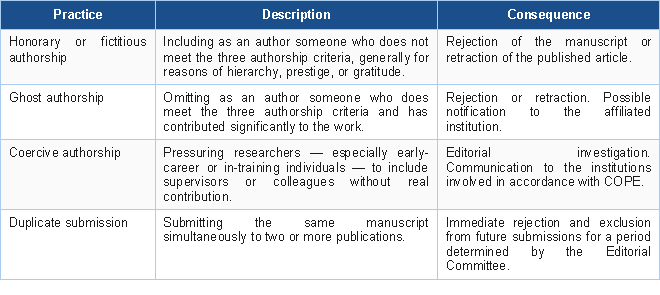
In the face of any allegation of improper authorship practice, the journal will act in accordance with the procedures and decision flowcharts of the Committee on Publication Ethics (COPE), available at https://publicationethics.org/
7. Authorship and Artificial Intelligence

one of principle: academic authorship implies intellectual, legal, and ethical responsibility that no AI system can assume. AI cannot consent to submission, cannot be held accountable for errors, and cannot be called upon by the academic community.
The use of artificial intelligence tools in the research process or manuscript preparation does not modify this provision. What is required is the declaration of such use in the corresponding form, in accordance with the three-tier model established in the journal's Artificial Intelligence Use Policy (Section 6 of the Author Guidelines, Version 1.0, 2026).

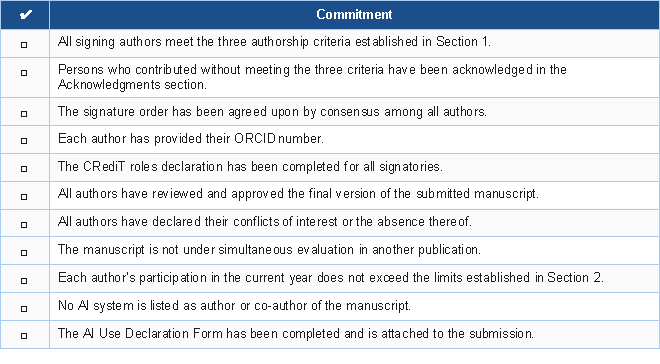
8. Authorship Checklist
Before submission, all authors must confirm that the following points have been met. Signing the cover letter to the editor implies acceptance of these commitments.