Interoperability protocol
1. OAI-PMH Protocol
1.1 What it is and why we implement it
The Open Archives Initiative Protocol for Metadata Harvesting (OAI-PMH) is the international standard protocol for automated metadata exchange between repositories and scientific information systems. Developed by the Open Archives Initiative, it is adopted by the major academic databases, institutional repositories, and discovery services worldwide, including DOAJ, Latindex, Redalyc, SciELO, BASE, and CORE.
The implementation of OAI-PMH allows the metadata of each article published in this journal to be harvested automatically by external service providers, without manual intervention and in real time, ensuring that the content is visible and retrievable on multiple platforms from the moment of publication.
1.2 OAI-PMH Access Point
The journal's platform, operated on Open Journal Systems (OJS), automatically exposes an OAI-PMH access point at the following base address:

Note: The definitive URL of the OAI-PMH access point will be published on the journal's website when the platform is in production. This address must be registered in the indexing request forms for DOAJ, Latindex, Redalyc, and Scopus.
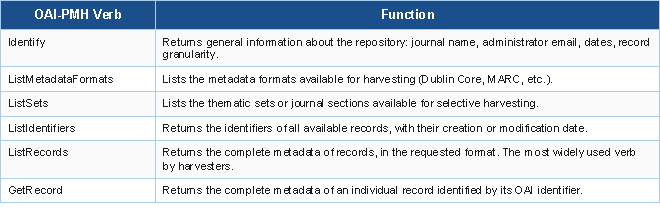
1.3 Supported OAI-PMH Verbs
Through the OAI-PMH access point, external systems can execute the following standard queries:
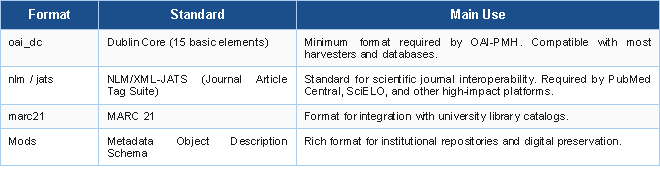
1.4 Available Metadata Formats
2. Dublin Core Elements Implemented
Dublin Core is the minimum metadata schema required by the OAI-PMH protocol. The journal implements all 15 elements of the standard Dublin Core schema (ISO 15836) for each published article. The following table specifies how each element is mapped to article data:
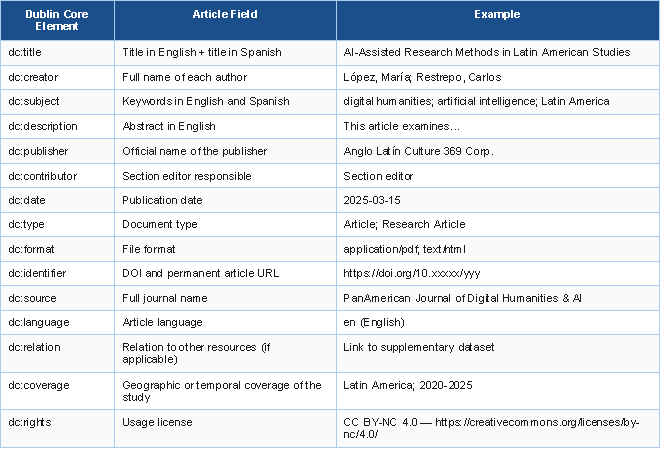
3. HTML Meta Tags for Web Discovery
In addition to the OAI-PMH protocol, the platform incorporates standard meta tags in the HTML code of each article page. These meta tags, located in the <head> section of the code, allow search engines such as Google Scholar, Semantic Scholar, and Bing Academic to index the content with structured and precise information.
3.1 Meta Tags Implemented per Article
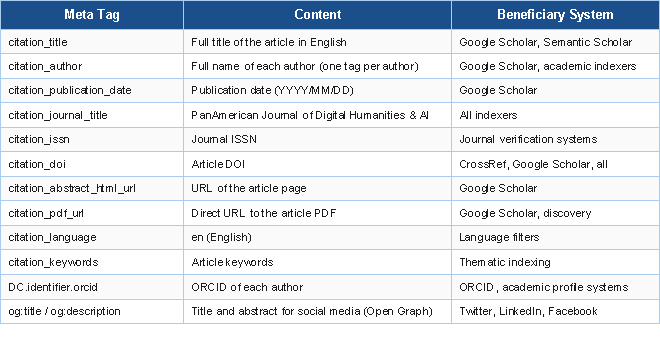
3.2 Implementation Example
The following fragment illustrates how the meta tag block is structured in the HTML page of each published article:
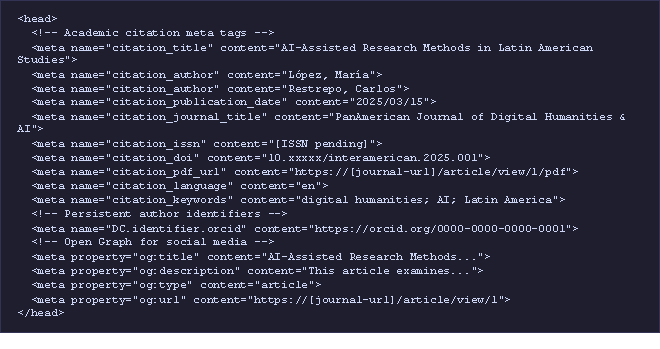
4. Persistent Identifiers
Persistent identifiers are the mechanism that ensures each digital object published by the journal can be found, cited, and retrieved permanently, regardless of changes to the website URL or technological infrastructure.
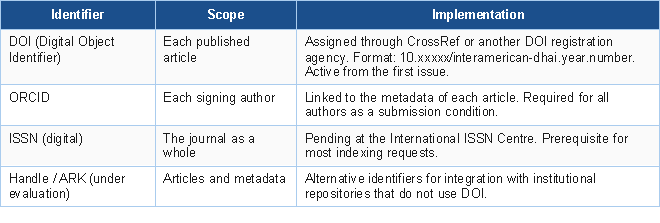
5. XML-JATS Format for Editorial Interoperability
The Journal Article Tag Suite (JATS / NLM) is the XML standard for the structured representation of scientific articles. It is required by SciELO, PubMed Central, and other technically demanding systems. Its implementation enables:
- Long-term preservation of content in machine-readable format.
- Full-text harvesting — not just metadata — by bibliometric analysis and text mining systems.
- Interoperability with the most technically demanding indexing platforms (SciELO, PubMed Central).
- Automatic generation of multiple output formats (PDF, HTML, ePub) from a single XML source.

6. Schema.org Structured Data
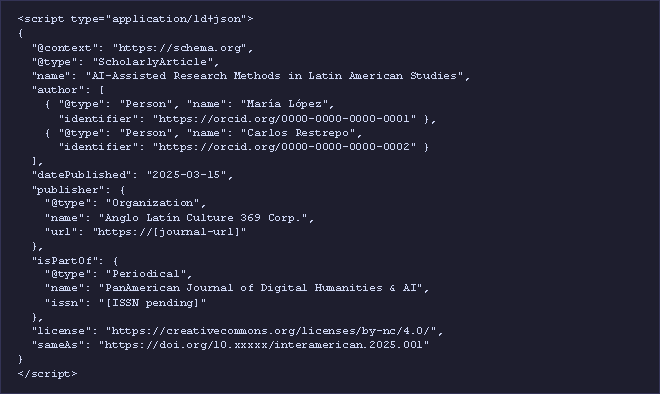
In addition to citation meta tags, the platform implements structured data in JSON-LD format according to the Schema.org vocabulary. This structured data allows general search engines (Google, Bing) to understand the nature of the content and present it in rich results.
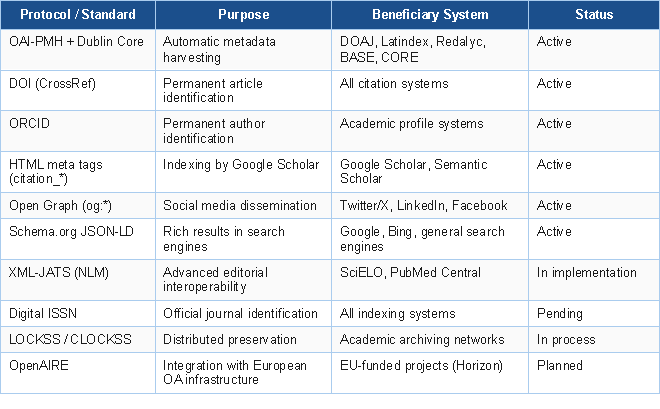
7. Protocol and Integration Map
The following table consolidates all protocols and integrations implemented or planned by the journal, with their current status and main beneficiary system: